

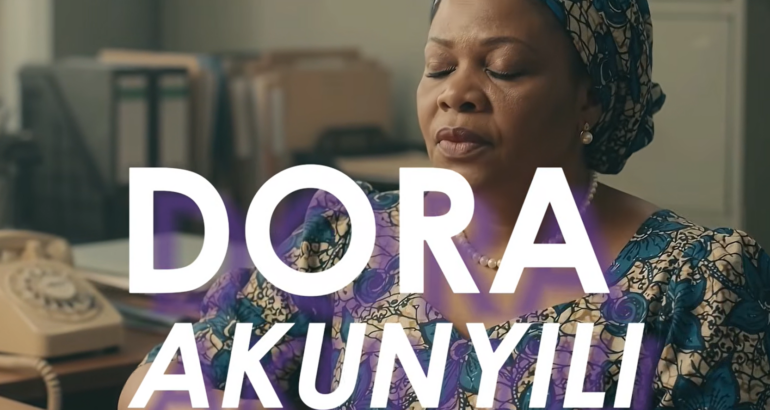
Backstory: In 1988, a woman lost someone she loved to a vial of insulin with nothing inside it. Thirteen years later, she was put in charge of NAFDAC, the agency that was supposed to stop that from happening again, and she found the counterfeiters had already bought their way through its doors. She went after them in the markets and inside her own office, and they came after her with fire and bullets. On the day after Christmas, on the road to her hometown, the night cracked open, glass shattered, and a bullet tore through her scarf. The men who wanted her dead weren’t terrorists or political rivals, and what she had taken from them was worth billions. Three days later, she went back to work.

Read the Transcript
Arise, O compatriots, Nigeria’s call obey…
Forgive me. That’s yesterday’s anthem.
Nigeria, we hail thee, Our own dear native land, Though tribe and tongue may differ, In brotherhood we stand…
Tribe and tongue may differ. Brotherhood may not always hold. But there is one thing that has never respected the lines between us.
Death!
It doesn’t ask what tribe you were born into, what language you pray in, or whose side you stand on. It walks into the rich man’s house and the poor man’s the same way. And in Nigeria, at the turn of the century, death had found itself a quiet accomplice: the very medicine people trusted to heal them.
Today, if you fall sick, the process is simple. You see a doctor. You get a prescription. And if you have a trusted HMO behind you, your medicine is verified, covered, and delivered straight to you. No guesswork. No gamble on whether what you’re taking is real.
That is what healthcare is supposed to feel like. Simple. Safe.
Not long ago, nobody could promise you that.
It was the day after Christmas. A woman was travelling to her hometown of Agulu, having just celebrated the holiday with her husband and their six children. She was reflective. Grateful. But restless too. The counterfeit drug barons she’d been hunting would not rest, and some part of her knew she couldn’t either.
Then the night cracked open.
Gunfire erupted, shattering glass, tearing through metal. Bullets pierced her scarf and grazed her scalp. Her driver swerved violently as headlights from a pursuing vehicle cut through the darkness behind them.
It was an ambush. One of the many death threats against her had finally come to life.
She survived.
She went back to work three days later.
Now imagine what it takes to go back to work after someone tries to kill you.
Her name was Dora Akunyili. And the people who tried to kill her weren’t terrorists, or political rivals. They were drug counterfeiters. The woman they were trying to silence had declared war on an entire criminal industry, and she was winning.
To understand why anyone would target a government regulator, you have to understand what Nigeria’s drug supply looked like at the turn of the century.
Fake antibiotics that did nothing. Diluted vaccines. Anti-malarial tablets made of chalk. Counterfeit and substandard medicine had become so widespread that ordinary Nigerians had learned to live with the risk, because there was no real way to tell real medicine from fake.
For most people, this was an abstract statistic. For Dora Akunyili, it was personal.
In 1988, her sister Vivian, a diabetic, injected what she believed was insulin. The vial was fake. It contained no active ingredient at all: nothing to lower her blood sugar, nothing to save her life. She died from a medicine that was never medicine.
Akunyili never forgot. She carried it for thirteen years, through a career in pharmacology and public service, until in 2001 President Olusegun Obasanjo handed her an agency most Nigerians had never heard of: NAFDAC, the National Agency for Food and Drug Administration and Control.
On paper, it was a regulatory body. In practice, it was about to become a battlefield.
Akunyili didn’t run NAFDAC from behind a desk. She led raids herself. Idumota Market in Lagos and the pharmaceutical markets of Onitsha, some of the largest counterfeit drug hubs in West Africa, had operated for years with near impunity. She marched into them anyway, with agency officers and, when necessary, armed escorts, seizing and destroying container-loads of fake and substandard drugs in full public view.
She named companies. She published lists of banned products. She shut down manufacturers that had been quietly poisoning the country for years. And she did it loudly, on television, in newspapers, in front of cameras, because she understood what her predecessors hadn’t: silence was what had let this industry thrive in the first place.
But the raids were only half the fight. The other half happened inside her own agency.
Before Akunyili, counterfeiters didn’t need to sneak drugs into Nigeria. They paid their way in. Officials at ports and border crossings routinely cleared fake and substandard products for a price. So her first task wasn’t chasing criminals in the market. It was cleaning out the corruption inside the system meant to stop them.
She dismissed compromised staff. She tightened registration and port-of-entry inspection, so that no product could legally enter the country without real verification. She built public education campaigns to teach ordinary Nigerians how to spot a fake before they ever swallowed it.
None of this was dramatic. All of it was structural. And it’s why regulators across Africa still study the NAFDAC model today: not for the raids, but for how she rebuilt the system so the raids would actually matter.
“Drug counterfeiting, facilitated by corruption, kills en masse, and anybody can be a victim.” — Prof. Dora Akunyili
The counterfeiters did not go quietly. Akunyili received death threats routinely. Her house in Enugu was set on fire. And the ambush in Agulu nearly finished what the threats had promised.
With the nation watching to see whether she would step back, she did the opposite. She went back into the field.
By the time her tenure at NAFDAC ended in 2008, fake and substandard drugs had been driven back from Nigeria’s markets on a scale few regulators anywhere have matched. International bodies took notice, and the recognition followed, including Transparency International’s Integrity Award in 2003. But the measure that mattered most was never on a plaque. It was the sick people, in clinics and homes across the country, who took their medicine and could trust, for the first time in years, that it was real.
The fight Akunyili led didn’t end when she left office. Counterfeit and substandard medicine remains a global health threat. The World Health Organization estimates that roughly one in ten medical products in low- and middle-income countries is substandard or falsified. The war she fought is still being fought, in different markets, under different names.
But the standard she set, an agency that couldn’t be bought and a system built to verify before it trusted, is still the benchmark.
“Corruption in the health sector is murder.” — Prof. Dora Akunyili
At Avon Healthcare, we believe that fight doesn’t end with one hero, one agency, one raid. It continues every single time a patient sees a doctor, gets a prescription, and trusts, without hesitation, that what reaches them is real, because a system, and an HMO, stood between them and the counterfeit, the corrupt, the compromised.
Healthcare only works when it can be trusted. And trust is the one thing corruption can never fake.
THE HARD QUESTION TO PONDER
Dora Akunyili didn’t have the power to rewrite the law. She had the power to enforce it: loudly, publicly, and at real personal cost.
The old anthem once asked whether the labour of our heroes would be in vain.
Today, with our healthcare sector under strain, that question comes back.
Will the labour of our heroes past be in vain?
Pulse Heroes. An Avon HMO Series.
To watch all Pulse Heroes Series: Click Here


