

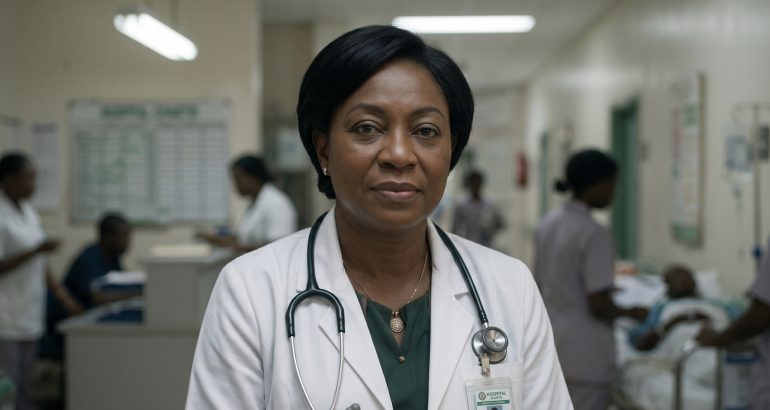
Backstory: When a Liberian diplomat arrived in Lagos carrying the Ebola virus, Dr. Stella Adadevoh made the decision to quarantine him against institutional and diplomatic pressure. Her decision saved Lagos, a city of over 20 million people, from an epidemic that could have been catastrophic.

Read the Transcript
Do you remember what Lagos was like in 2014? Let me remind you. Dorobucci is everywhere. Every car. Every speaker. Every corner of Lagos. You can’t escape it. The Shoki is the dance of the moment, everybody is doing it. Weddings. Parties. Traffic jams. It doesn’t matter. If you were in Lagos in 2014, your body was moving. The Super Eagles are heading to the World Cup in Brazil. P-Square is breaking up, or maybe not, and the whole country has an opinion. Davido’s “Aye” is making everybody want to fall in love. Nigeria just lost Dora Akunyili, and the tributes haven’t stopped pouring in. Twenty-one million people packed into one of the most alive cities on the face of the earth. That was Lagos. That was the energy. And nobody, nobody, had any idea that the biggest drama of 2014 hadn’t even started yet.
Now here’s what was happening at the exact same time that nobody was paying attention to. Every single government hospital in the city was shut down. Closed. The doctors were on a nationwide strike. No emergency rooms. No public clinics. Nothing. And out in West Africa, while Lagos was dancing, a virus was burning through three countries at the same time. Guinea. Sierra Leone. Liberia. People were bleeding from their eyes. Entire families were being wiped out in days. Health workers were dying faster than they could be replaced. There was no vaccine. No cure. No treatment. This virus kills up to ninety percent of the people it touches. Its name is Ebola. On July 20th, while Afrobeat was growing into a global force, a man named Patrick Sawyer boarded a flight from Monrovia, Liberia. He was a diplomat.
An ECOWAS official on his way to a conference in Calabar. He had a connecting stop in Lagos. But here’s what nobody on that plane knows. Patrick Sawyer has just left quarantine. He is carrying the Ebola virus inside his body. And he has just landed, in a city of twenty-one million people where there are no government hospitals open to receive him. He collapses at Murtala Muhammed International Airport. They rush him to the only place they can, a private hospital called First Consultants Medical Centre. He arrives on a Sunday. The first doctor who sees him runs a blood test, checks for malaria, and diagnoses him with a bad case of it. Meanwhile, Dr. Stella Ameyo Adadevoh, the hospital’s lead consultant physician, is not even there. She has no idea what just walked through her hospital’s front door.
Monday morning. She walks in. And this is where the entire story turns. Now, to understand what happens next, you need to know who this woman was. Stella Adadevoh was the great-granddaughter of Herbert Macaulay, the man on your one naira coin, the founding father of Nigerian nationalism. She was the grand-niece of Nnamdi Azikiwe, Nigeria’s first president. Her father was a physician, a former Vice Chancellor of the University of Lagos. Medicine was in her blood. Service was in her DNA. She trained in London. She could have stayed there. She chose to come back. She spent twenty-one years at First Consultants, the same hospital where her own son was born. She was the first doctor to diagnose swine flu in Nigeria in 2012.
So when she walks into that ward on Monday and sees Patrick Sawyer, she immediately knows something is wrong. This is not malaria. She runs a full blood count. Normal. She tests for HIV. Negative. Hepatitis. Negative. Two days. No diagnosis. And the man is getting worse. Then she sees it. Blood. Seeping through his skin. She asks him one question: where have you been? He says Liberia. And in that moment, everything clicks. Dr. Stella Adadevoh knows exactly what she is looking at. She has never seen Ebola before. But she knows. She goes online. Searches everything she can find about Ebola. Prints copies. Distributes them to every nurse, every doctor, every ward attendant in the building. She picks up the phone and calls Professor Abdulsalami Nasidi at the Nigeria Centre for Disease Control in Abuja. She sends blood and urine samples to Lagos University Teaching Hospital. The results come back. Ebola. Confirmed.
The first case ever recorded in Nigeria. And then she does something that most people would not have the nerve to do. She writes, in bold letters across his medical chart, that under no circumstances is this patient to leave this hospital. Now, understand what is about to happen here. This is not a minister of health. This is not a government official with the backing of an institution. This is a private hospital doctor, a woman about to stand up against diplomats, ambassadors, and an entire system that is telling her to stand down. In a country where challenging authority can end your career, she is about to challenge everyone. Imagine you are Patrick Sawyer. You are an ECOWAS diplomat. You have a conference to attend. You have an 11 AM flight to catch. And some doctor at a private hospital is telling you, you cannot leave. He is furious. He says it’s malaria. He demands to be discharged. She says no.
An ECOWAS official arrives and tells Dr. Adadevoh the patient needs to leave immediately. She says no. The Liberian ambassador starts calling. He accuses the hospital of kidnapping a diplomat. He threatens legal action. He says they are violating his fundamental human rights by holding him without a confirmed diagnosis. She says no. And then she says five words. Five words that will draw a line between what happened in Nigeria and what happened everywhere else. “For the greater public good.” There is no isolation unit at First Consultants. There is no Ebola-grade protective equipment. No hazmat suits. No sealed rooms. So Dr. Adadevoh and her team build a wooden barricade outside Sawyer’s door. Not a metaphor. A physical, wooden barrier, because that is all they have. They wear gloves. Shoe covers. Face masks. And they pray. And while all of this is happening, while this woman is fighting to keep a plague from walking out of a hospital in Obalende, you’re at home. You have no idea. Nobody does.
The hero of 2014 is not on your TV. She’s not trending. She’s not on any blog. She’s standing in a corridor with a wooden barricade and a decision that will save our lives, and we don’t even know her name. Patrick Sawyer dies on July 25th. On August 4th, Dr. Stella Adadevoh tests positive for Ebola. Her son, Bankole, visits the isolation centre. The first day, he can stand by the window and talk to her. The second day, the same. He brings her towels and slippers to make her comfortable. Then, suddenly, they won’t let him near the window anymore. On his birthday, a Sunday, it looks like she might pull through. The doctors say she’s a fighter. Then Monday comes. They call the family into a room and say: it’s not a matter of days anymore. It might be hours. On August 19th, 2014, exactly thirty days after she made the decision that saved this city, Dr. Stella Ameyo Adadevoh dies. She was fifty-seven years old. She had one son. She held no political office. Her name was on no billboard. Now here’s the part of this story that will stay with you. Because of her decision, because she refused to let one man walk out of that hospital, every single Ebola case in Nigeria was traced back to a single chain of transmission. Not hundreds of chains. Not dozens. One. Twenty total cases. Eight deaths. In a country of over a hundred and ninety million people. In Guinea they lost thousands. In Sierra Leone thousands.
In Liberia eleven thousand. In Nigeria eight. Because one doctor said no when everyone told her to say yes. After she died, Nigeria built its first Ebola Emergency Operations Centre. They traced eight hundred and ninety-nine contacts. The WHO declared Nigeria Ebola-free in ninety-three days. The entire country’s response became a global model for pandemic containment. Every protocol. Every framework. Every system that made that possible, it didn’t start with a government directive or an international agency. It started with a woman, a wooden barricade, and a decision. And that’s the thing nobody tells you about healthcare systems. Healthcare thrives because people choose to care. One decision at a time. One act of courage that nobody asked for and nobody rewarded until it was too late.
The question isn’t whether the next crisis is coming. It’s whether someone will be standing in the doorway when it arrives.
All Pulse Heroes Series: Click Here


